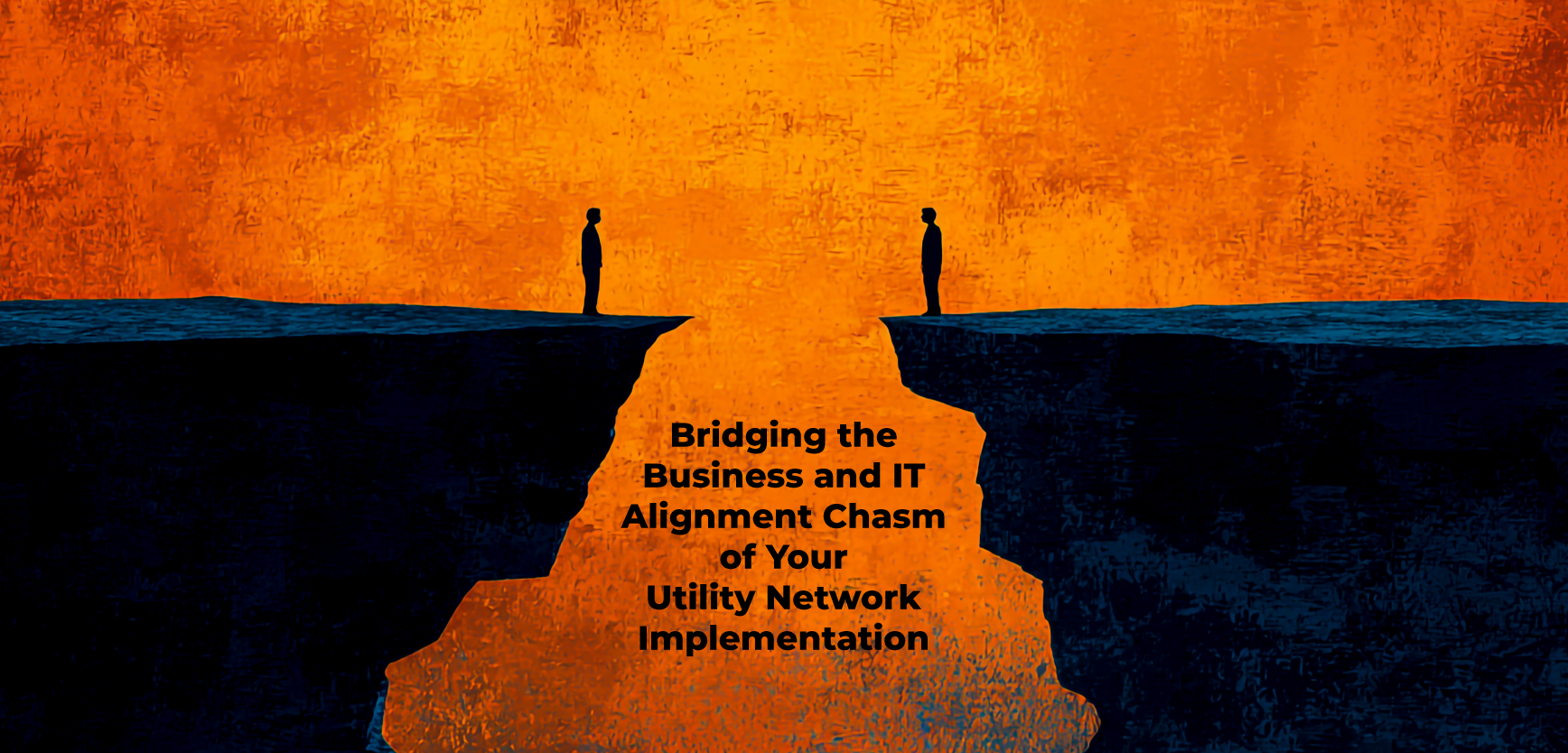
Does it seem that an unbridgeable divide exists between business units and IT within your utility? Are there significant differences in opinion between IT and business when it comes to governing your GIS program? Is there a negative emotion or attitude toward the IT group responsible for your existing GIS technology delivery and support? If you answered yes to any of these questions, then it would be advisable to address the root cause of the misalignment before proceeding with your migration to Esri’s next-generation ArcGIS Utility Network (UN) platform. Otherwise, you will be adding to an already long list of technical and organizational challenges that frequently accompany an organization’s migration to the UN.
Misalignment Factors
Business and IT misalignment often stems from a lack of communication, siloed departments, and conflicting priorities. It occurs when IT operates as a cost-focused support unit rather than a strategic partner, exacerbated by a poor understanding of business goals by IT and technical constraints by leadership. Several core factors contributing to the alignment chasm include:
- Conflicting Objectives: Disconnect between advancing utility operational demands and slow-moving, risk-averse IT solution and service delivery.
- Ineffective Communication: Lack of understanding between technical support and business unit teams.
- Disconnected Strategies: IT goals not tied to business objectives, often because IT leaders lack sufficient understanding and engagement with leadership.
- Siloed Organizational Structure: IT and business units working in isolation, leading to redundant efforts and fragmented goals.
- Legacy Technology: Outdated infrastructure that cannot support the increasing utility operational needs.
- Constrained Resource: Under-investing in technology or viewing IT as a cost center, forcing business units to compete for limited resources.
- Missing Sponsor Support: Lack of active and visible sponsorship, reducing the likelihood that the project will meet its objectives.
- Lack of Business Feedback: Business leadership is failing to evaluate if an IT project delivered the intended business value
Far too often, misalignment results in the wrong technology decisions and investments, missed or lacking business requirements, and low stakeholder engagement in the project. This is particularly the case with the technical and organizational complexities often associated with enterprise GIS implementations. If a significant misalignment exists, the organization will undoubtedly experience a lower return on its investment.
Value Proposition of a Modern GIS Platform
Today, it would be difficult for a utility to effectively accomplish the countless planning and engineering, asset mapping, field services and inspections, network operations, asset management, and customer service functions without the use of GIS. For most utilities, GIS has become a ubiquitous and necessary organizational resource for supporting the operational needs across the utility.
- Sponsorship Engagement. A collaborative relationship between the business and IT leadership is required to achieve alignment. Business and IT leadership need to be actively and visibly engaged in the project on a consistent basis.
- Shared UN Project Vision: Create common objectives where IT projects are directly tied to business value and objectives rather than just operational efficiency.
- Communication and Visibility. Consistent and effective communication will facilitate understanding and promote mutually beneficial thinking about business and IT governance. Communication needs to start at the leadership level with the view that GIS is a business resource that is used to achieve business results.
- UN Project Cross-Functional Teams: Embed IT professionals within business units to foster collaboration and understanding of operational needs.
- Governance Process and Structure. A formal enterprise GIS governance process should be in place to support strategic decision-making to ensure successful alignment. Having an organizational structure that provides mechanisms for accountability and ownership ensures that both IT and business will be held accountable when UN project objectives are not met.
- GIS as a Business Enabler. GIS needs to be perceived by business and IT leadership as a resource and a business enabler. This perception needs to be instilled across the utility to ensure new GIS capabilities that emerge are recognized and support business objectives.
- Organizational Change Management. Apply a structured, people-focused methodology to the UN project, ensuring technology, processes, and people are integrated.
- Management Capability Level. Management capability needs to be well developed in both IT and business managers. Business managers must have a good understanding of technology and IT management must have a solid understanding of the business functions of the organization.
These strategies will vary across the individual, group and organizational levels, indicating that successful alignment is complex and requires transformation of both individuals and groups involved in the UN migration. It is important to note that the decision maker’s skills and capability are likely one of the most important factors in achieving successful alignment.
CIOs want to be more involved in business strategy development; however, CEOs do not always believe that to be necessary. CIOs would also like to see more CEO involvement in overall IT strategy development, but again CEOs may not believe it’s needed. Even today, some CEOs perceive that business and IT decision makers need only be involved in their individual strategy development process.
Don’t underestimate the effort it may take to bridge the business and IT alignment chasm. Decades of cultural and past practices continue to foster misalignment among leadership as GIS continues to become strategically significant. The chasm closing strategies presented above suggest where utilities should focus their attention if alignment between business and IT is essential for ensuring a successful migration to the UN.

What do you think?