As utilities continue to modernize GIS, many are preparing to migrate to Esri’s Utility Network, a comprehensive data model designed to support the complex connectivity, topology, and data integrity needs of modern utility networks. One crucial yet often underappreciated step in this process is conducting a source record validation project to update and validate asset attribution. Whether your organization is still in the planning stages or deep into a migration roadmap, here’s why source record validation should be a priority for any GIS team preparing for the Utility Network.
What is Source Record Validation?
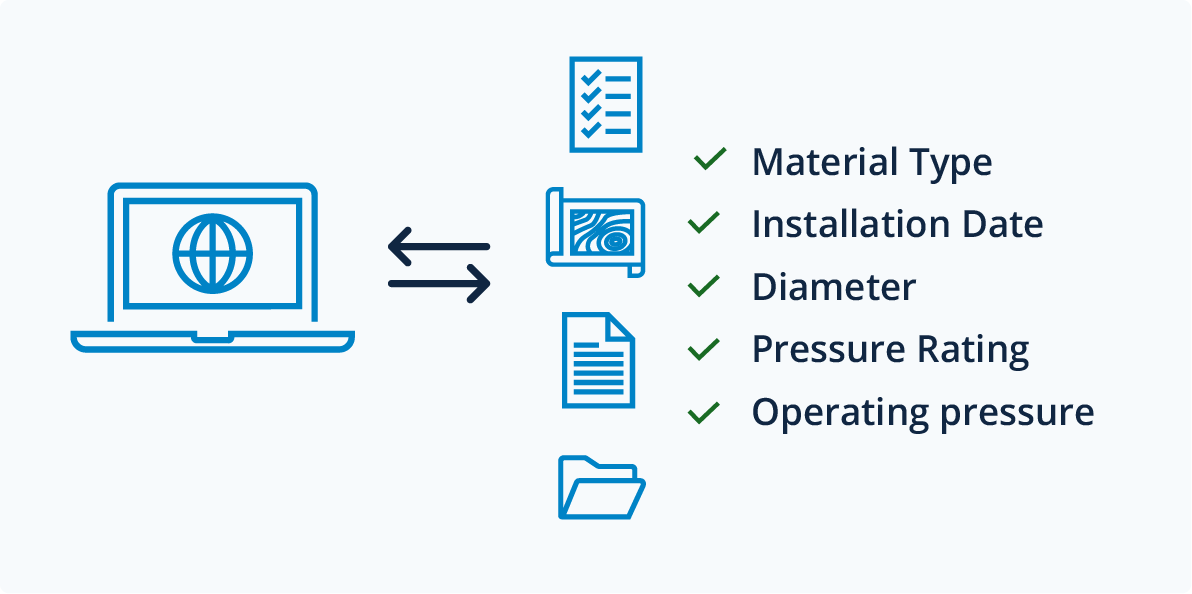
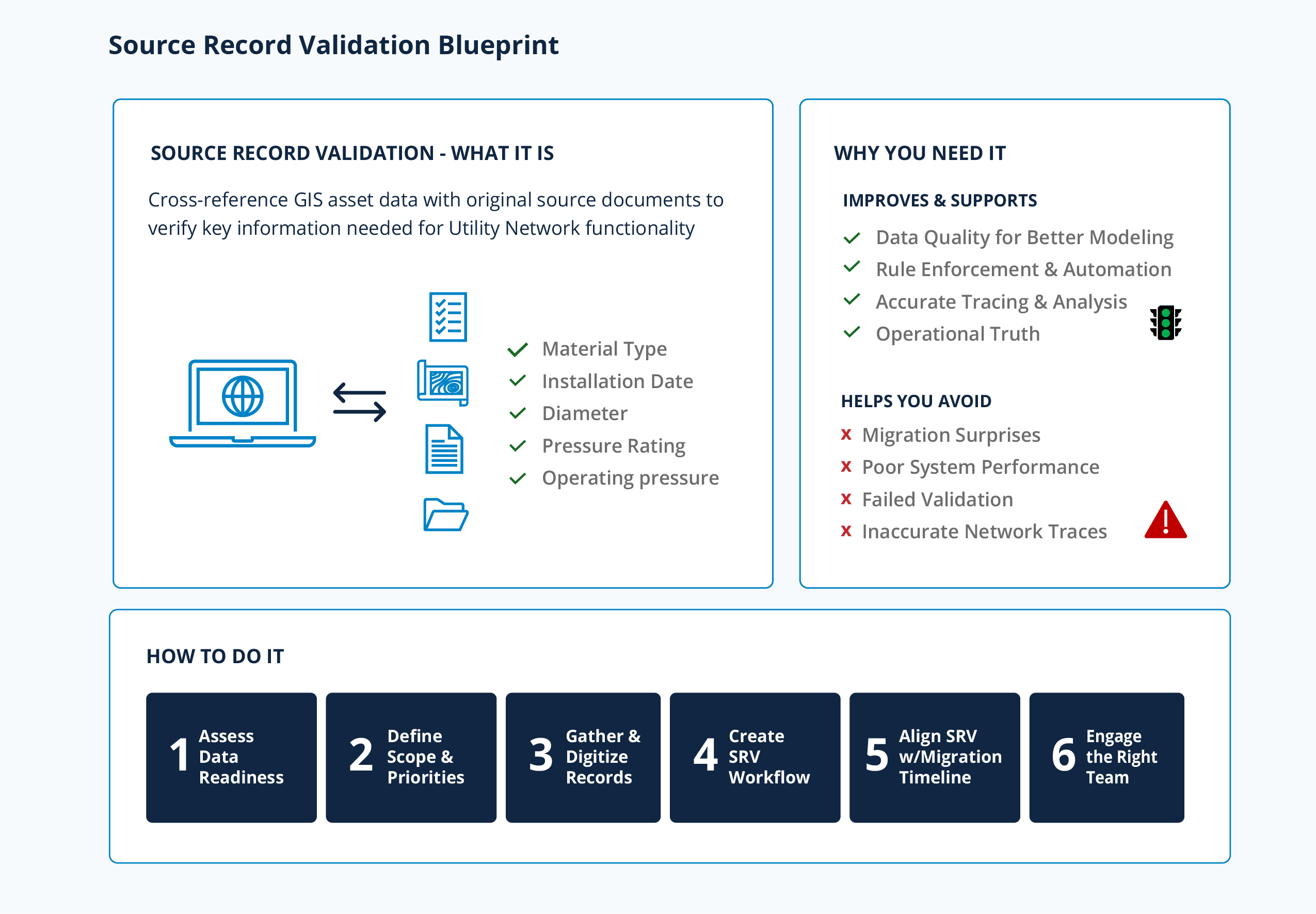
Source record validation involves cross-referencing GIS asset data with its original source documents, such as construction as-builts, inspection records, work orders, and field notebooks, to ensure that asset attributes are complete and accurate. This process is essential for verifying key information like material types, installation dates, diameters, pressure ratings, and operating pressures.
Why it Matters for Utility Network Migration
Esri’s Utility Network places a much higher emphasis on data integrity, accuracy, and relationships than the geometric network model it replaces. As a result, incomplete or incorrect data can lead to issues ranging from poor system performance to failed validations or inaccurate network traces.
Here’s how source record validation sets your team up for success:
- Improves Data Quality for Better Modeling
The Utility Network relies on rich attribution and rules-based connectivity. Inaccurate or missing attributes can break the model, literally. For example, a missing pipe material or pressure system value can cause network rules to fail or prevent assets from correctly associating or connecting with other assets. Source Record Validation ensures you’re working with clean data that can be trusted before migrating. - Enables Rule Enforcement & Automation
With accurate asset attribution, you can fully leverage the Utility Network’s powerful capabilities like attribute rules, contingent values, and validations. These features help automate data entry, reduce user error, and maintain data integrity. But they only work if your foundational data is solid. - Supports Accurate Tracing and Analysis
One of the most valuable aspects of the Utility Network is advanced tracing. Traces depend not only on connectivity and spatial relationships but also on correct asset attributes such as material, valve position, and asset types. Source record validation ensures your GIS can support accurate trace results which are critical for emergency response, asset management, and system planning. - Reduces Migration Surprises
A source record validation effort can help identify discrepancies, gaps, or legacy data issues long before they become blockers during the migration. It’s much easier to resolve these issues upfront than in the middle of a full-scale conversion. This proactive step improves the entire project. - Aligns GIS with Operational Truth
GIS is often used as the system of record for utility assets, but only when it truly reflects what’s in the field. Source record validation connects the dots between GIS and operational documentation, improving confidence across departments from engineering to compliance to field operations.
Getting Started
Starting a source record validation project doesn’t mean you need to verify every asset in your system. Many utilities start with high-impact areas such as:
- Steel and plastic mains and services
- High-pressure distribution and transmission systems
- Regulator stations and valves
- Isolation zones or cathodic protection areas
From there, validation can be phased in to align with migration sprints. Leverage tools like ArcGIS Pro attribute rules, Python scripts, or database queries to help identify suspect data and prioritize records for review. The key is to prioritize, plan, and execute in phases aligned with your migration roadmap and operational priorities.
1. Assess Data Readiness
Start by evaluating the current state of your GIS asset attribution.
Key questions:
- What percentage of key assets have missing or default values (“unknown” or “null”)?
- Are critical attributes like material, diameter, install year, and pressure system populated?
- Are source documents available and accessible (digitally or on paper)?
Tools to support this:
- SQL queries to find missing attributes
- ArcGIS Pro attribute rule checks
- Data quality dashboards in ArcGIS or third-party tools (Power BI)
2. Define Scope & Priorities
You don’t need to validate every asset to get value. Focus on high-impact assets or regions, such as:
| Priority Focus Areas | Reason |
|---|---|
| Transmission pipelines | Safety & regulatory compliance |
| High-pressure distribution | Impacts system tracing and gas flow modeling |
| Isolation zones/valves | Affects emergency response workflows |
| Areas targeted for migration sprints | Aligns data readiness with technical rollout |
Also consider:
- Regions with recent construction (easier to validate)
- Regions with poorly documented or legacy systems
3. Gather and Digitize Source Documents
Work with engineering, operations, and records departments to:
- Locate source as-builts, field markups, work orders, and inspection reports
- Scan paper records and organize by document type, region, or work order number
- Consider implementing a document management system and linking source documents to GIS features.
Even if full digitization isn’t possible, creating a reference index of available records can speed up manual review.
4. Build Your Validation Workflow
Once you’ve identified which records to validate and gathered source materials, create a repeatable process:
Basic SRV Workflow:
- Organize assets by priority (all plastic mains over 2” diameter in Zone A)
- Review each asset’s current attributes in GIS
- Compare against source documents
- Update attributes and log the validation
- Flag records with unresolved discrepancies or no documentation
5. Phase Validation with Migration Timeline
Align SRV efforts with your Utility Network migration phases:
| Migration Phase | Source Record Validation Activity |
|---|---|
| Planning & design | Identify data gaps & high-priority areas |
| Configuration & testing | Validate sample datasets used in testing |
| Pilot migration | Perform focused SRV in pilot areas |
| Rollout by zone/region | Parallel SRV with phased UN deployment |
Phasing helps spread workload, build momentum, and learn as you go.
6. Engage the Right Team
Successful SRV projects involve cross-functional collaboration:
| Role | Responsibility |
|---|---|
| GIS Team | Attribute audits, data updates |
| Records Staff | Source document access |
| Engineering | Technical validation of asset data |
| Field Operations | Field verification or gap filling |
| IT/GIS Analysts | Automation, reporting, data tracking |
Final Thoughts
Migrating to the Utility Network is more than a technical upgrade. It’s a strategic investment in better data, smarter analysis, and long-term operational efficiency. A well-executed source record validation project creates the foundation for a smooth transition and positions your organization to fully realize the benefits of Esri’s next-generation GIS model.

What do you think?